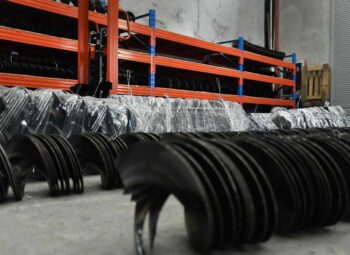

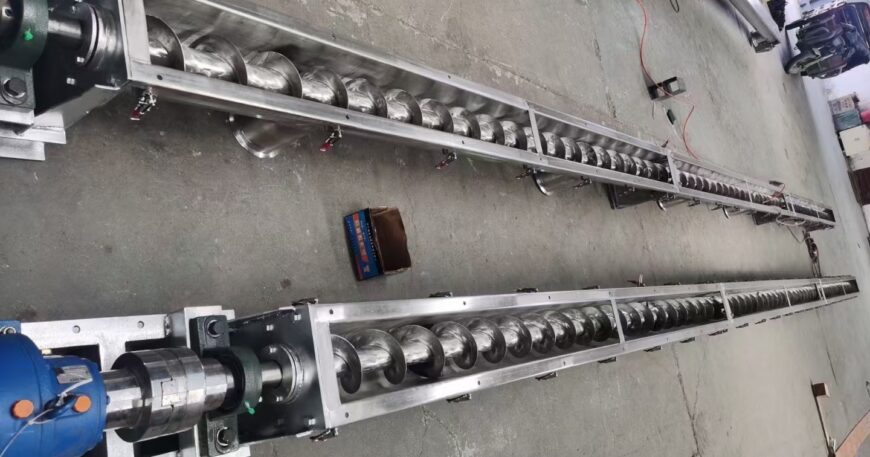
Installation and commissioning of screw conveyors: The complete process from pre-installed bolts to load test run
- Pre-installation of support or suspension bolts:
The foundation or suspension frame (bolts) of the screw conveyor should be poured or pre-installed before the official installation. The size of the frame or suspension frame should be determined according to the process requirements, and the installation should be pre-made. After installation, there should be no deformation, subsidence or other undesirable phenomena.
2. The sections from the nose to the tail are sequentially placed on the foundation (or frame), ensuring that the center lines of each section (including the head, tail, and middle section) do not deviate by more than the allowable tolerance specified in Table.
| Length of the screw conveyor(M) | 3-15 | 15-30 | 30-50 |
| Inconsistency (MM) | 4 | 6 | 6 |
- Shell joint misalignment and sealing
The misalignment at the joint of adjacent shell inner surfaces should not exceed 1 millimeter. It is required to be tightly sealed. The flange joint surface should also be sealed and a layer of asbestos or rubber gasket should be added between the flange surfaces.
4.Installation and adjustment of the suspension bearings: Install and adjust the suspension bearings to ensure uniform clearance between the spiral blades and the casing, and pay attention to making the spiral body rotate smoothly.
5.Final tightening and installation of the drive unit:After all the components of the machine have been adjusted and stabilized, tighten the anchor bolts. Install the reducer motor on the foundation or motor frame.
6.Requirements for coupling or chain drive:If the output shaft of the reducer is connected to the input shaft of the main unit through a coupling, the coaxiality tolerance should be 0.2 millimeters. If they are connected by a chain, the parallelism tolerance of the two shafts should not exceed 3 millimeters.
- Requirements for no-load and load tests
- No-load test for 30 minutes: There should be no impact phenomena. The temperature rise of each bearing should not exceed 20℃.
- Load test: The temperature rise of each bearing should not exceed 30℃.
- If any abnormal situation is found during the test, stop the machine immediately to eliminate the problem.
By strictly following these installation and commissioning steps, including basic preparation, bearing adjustment, and test run temperature rise limit, you can ensure that your screw conveyor operates reliably and efficiently in harsh bulk material handling conditions.
For professional support or customized solutions for screw conveyors, please contact our engineering team immediately. Send an email to our email address: [email protected]
We have spiral conveyors of various styles:https://www.bhconveyor.com/products/screw-conveyor/
About Us:
We have been deeply involved in the field of material conveying equipment and its accessories for 26 years. Our services include:
Free initial assessment
24-hour consultation service
Product customization
Need a Similar Product?
Send us your specifications or requirements — our engineers will review and get back to you within 24 hours.