

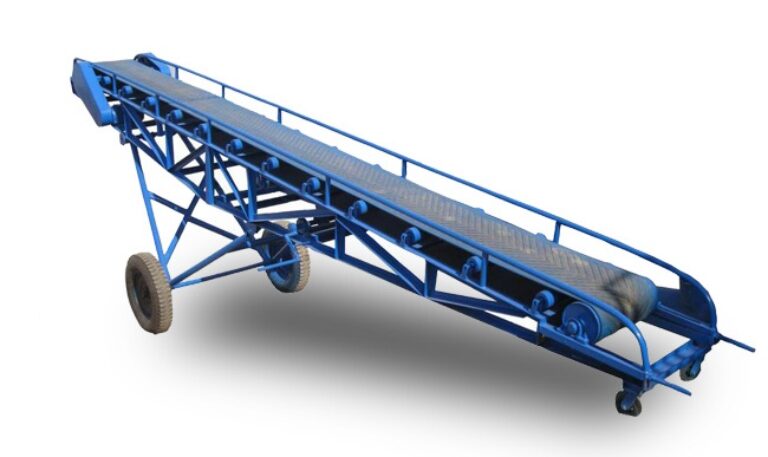
The DY Series Portable Belt Conveyor can be moved and adjusted in height and inclination. It is mainly used in industries such as mining, logistics, building materials, and grain and food material transportation. Common problems include belt deviation, material sliding, and machine body jamming. These issues often occur due to improper operation. Now, the standard operation steps will be briefly explained to ensure the smooth operation of the equipment.
1.Determine the direction and target location of material transportation in advance
Before starting the operation, it is necessary to plan the direction of material transportation, the positions for feeding and discharging, and determine the placement location of the equipment and the transportation path. Precise positioning is the basis for avoiding incorrect or missed material transportation, preventing material waste and operational hazards, and ensuring accurate material delivery by the equipment.
2.Precisely adjust the angle and lifting height of the belt conveyor
Adjusting the angle and height of the DY Series Portable Belt Conveyor according to the conveying height and material type is crucial for the stable transportation of materials. Before starting the machine, conduct no-load debugging of the equipment to match the belt inclination angle with the material conveying trajectory: for lightweight and slippery materials, a smaller inclination angle should be adopted; for blocky and heavy materials, a reasonable inclination angle can be selected to effectively prevent material slippage and accumulation.
3.Reasonably control the material conveying flow rate and operating speed
The material flow does not match the belt speed, which can easily cause equipment stalling, belt slipping, and material overflow. Therefore, it is necessary to reasonably control the material flow and operating speed of the DY Series Portable Belt Conveyor. During operation, uniformly and steadily feed the materials to avoid concentrated stacking. Adjust the speed according to the type of materials: for powder and granular materials, operate at a low speed to prevent dust, and moderately increase the speed for regular materials to improve efficiency.
4.Optimize the transportation plan based on the properties and forms of the materials
The forms and weights of different materials vary greatly, so the DY Series Portable Belt Conveyor‘s transportation method needs to be adjusted according to the properties of different materials. For powdery and granular materials, baffles and micro-tension belts should be installed to prevent leakage; for hard blocky materials, the supporting plates should be reinforced and the spacing of the idler rollers adjusted to avoid damaging the belt; for bagged materials, the belt should be leveled to prevent deviation and sliding.
5.Regular maintenance and servicing
Regular maintenance is the key to ensuring the long-term stable operation of equipment. It is necessary to carry out regular maintenance and periodic inspections of the DY Series Portable Belt Conveyor. Before and after the operation, check the wear and looseness of the belt, regularly calibrate the belt position and adjust the tension; promptly clean the residual materials in the equipment, inspect the lifting structure, motor and transmission components, and conduct regular maintenance to prevent potential faults in advance.
In summary, by properly positioning, adjusting the inclination angle, controlling the feeding speed, adapting to the materials, and conducting regular maintenance, one can reduce conveyor failures, enhance conveying efficiency, and extend the equipment’s lifespan.
If you need DY Series Portable Belt Conveyor and professional equipment operation solutions, please feel free to contact us to obtain customized industrial conveying equipment and exclusive technical support. Our email: [email protected]
Need a Similar Product?
Send us your specifications or requirements — our engineers will review and get back to you within 24 hours.